

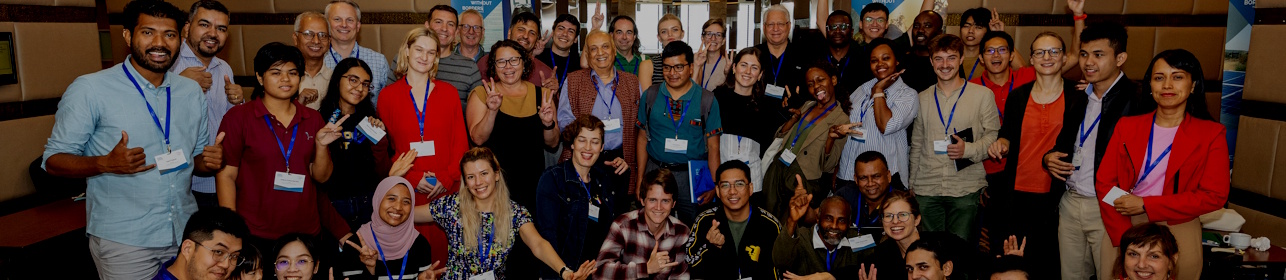


Across the Global Engineers Without Borders network of more than 57 organisations, engineers are mobilised to address the pressing issues of our time. In Uganda, this mission is being realised through the Nexus+ Programme; a partnership supported by Trimble Inc., coordinated globally by Engineers Without Borders International, and delivered locally by Engineers Without Borders East Africa supported by an expert advisory working group of the Builherthon.
A Childhood Memory, A Global Challenge
Peter S. Nzabanita, Executive Director of EWB–East Africa, recalls his childhood in Kisoro District: “I often walked 7 to 10 kilometers to fetch water from a single source called Chuuho. It was the only source of water that almost the entire district depended on.” His story is not unique. In Eastern Uganda, between 50–70% of people still lack access to safe water, reliable health facilities, and sustainable livelihoods. Funds exist to address these challenges, but they remain locked away because districts lack the data, tools, and engineering capacity needed to unlock them. Nexus+ is designed to change this reality.
Watch Video: https://www.instagram.com/reel/DYC6iX8jkSi/?utm_source=ig_web_button_share_sheet
The Role of Engineers Without Borders International
EWB International plays a critical role in ensuring that Nexus+ reflects shared values of co‑creation, trust, and global solidarity. As convener of the global network, it coordinates partnerships with industry leaders like Trimble and supports delivery through Engineers Without Borders–East Africa, demonstrating how global collaboration can unlock local impact. This stewardship makes Nexus+ more than a Ugandan initiative, it is a learning model for the entire Engineers Without Borders network, showing how evidence‑based planning, competency‑based learning, and scalable approaches can be replicated worldwide.
Lessons for the Global Network
The lessons emerging from Nexus+ are clear. Competency‑based learning is transforming engineering education, as students from Makerere, Kyambogo, Uganda Christian and Ndejje Univerities learn by doing—conducting surveys, asset mapping, and immersing themselves in farming practices. Communities are gaining credible master plans that unlock investment, while Trimble’s GNSS surveying tools elevate data accuracy and credibility with funders. By working across multiple parishes, Nexus+ avoids the “five‑year failure” cycle of conventional projects, creating economies of scale and attracting financing. These lessons are not confined to Uganda; they are insights that can strengthen practice across the global Engineers Without Borders community.
How Nexus+ Works
The programme unfolds in three phases: mobilisation and assessment, co‑design and technical planning, and investment packaging. Beyond 18 months, Nexus+ transitions into infrastructure installation and scaling across additional districts. Together, Engineers Without Borders International, Trimble, Engineers Without Borders–East Africa, and BuildHerThon are delivering measurable outcomes: more than 12,500 people gaining access to critical infrastructure and 10,000 students equipped with future‑ready skills.
A Blue Print for Engineering Focussed Organisations
Nexus+ is more than a project, it is a movement. It demonstrates how the Engineers Without Borders network combines global coordination, local delivery, and industry partnerships to achieve scalable, sustainable impact. Through Nexus+, stories like Peter’s childhood walk for water are being rewritten, transforming long journeys for unsafe water into community‑led solutions that bring infrastructure closer to home.
Find timely updates about the Nexus+ programme here: www.ewbea.org
Here is how a working group of female expert CEO’s is supporting the Nexus+ programme: https://buildherthon.com/insight/nexus-shows-what-buildherthon-looks-like-in-practice/
